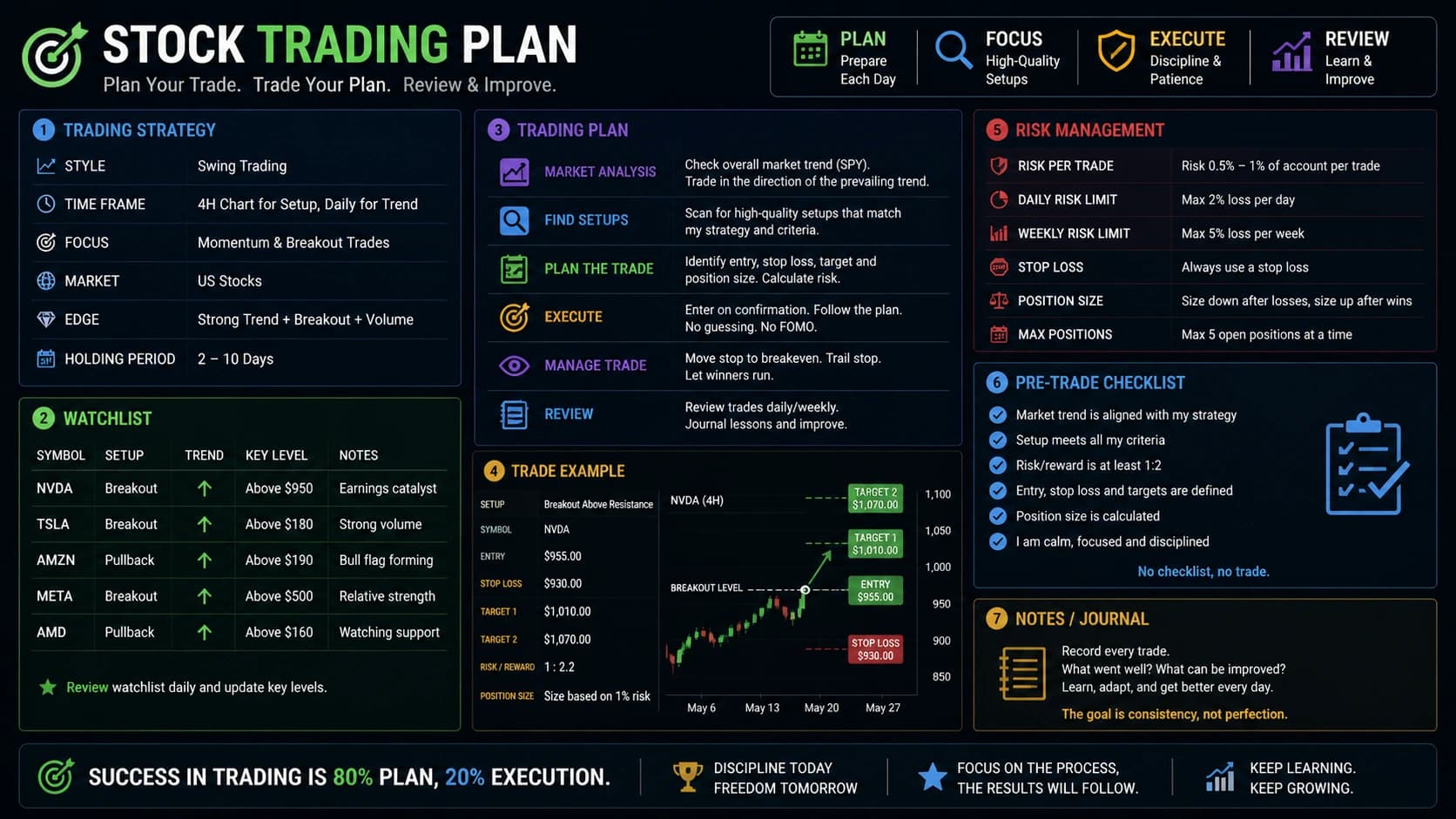
AAPL Apple - Trade Plan — 2026-05-18
Full run of trading-os (`/decide AAPL`) on 2026-05-18
TL;DR
Long AAPL via a conditional, scaled limit ladder into the $276–$282 pullback zone (blended anchor $279.00) — not a buy at the $300.23 spot, which the research verdict explicitly does not endorse. Hard stop $269.00 (below the $269–$272 high-volume support shelf), first target $303.20 (the 52-week high), second target ~$316.00 (Fibonacci extension of the April flagpole). Size is deliberately small at 2.48% NAV (89 shares, ~$24,831) risking only 0.089% NAV ($890) — the binding constraint is not the sizing math but the correlation cluster: AAPL is the third US mega-cap tech long alongside AMZ.US (3.5%) and MSFT (4.13%), and the cluster shares HYG as a kill-switch. Horizon 42 trading days, deliberately closing before the Q3 FY26 earnings binary (~2026-07-29).
Source verdict
From data/reports/AAPL/2026-05-18/research-verdict.md:
Decision. LONG — conditional pullback entry, not a buy-at-spot. The research view is directionally long AAPL with entry conditioned on the $276–$282 zone mapped by
technical.md. Spot at $300.23 is explicitly not the rating reference; a market-order long at spot is not endorsed by this verdict.Conviction. 3 / 5.
The verdict further instructs (Critical assumption 5):
Sizing respects the correlation cluster. AAPL is a third US mega-cap tech long alongside AMZ.US (3.5% NAV) and MSFT (4.13% NAV). The
memory.mdMSFT entry explicitly requires a correlation-cap recheck before adding a third correlated leg. The directional verdict is LONG; the size is for the trader and risk committee to set against the ~7.6% NAV already deployed in this cluster.
The direction (LONG), conviction (3), entry zone ($276–282) and invalidation level ($269.00) are taken as given. This plan decides only how to express the long.
Direction & instrument
LONG — common stock (cash equity), no options overlay.
Rationale:
- The verdict is LONG; the only decision here is the instrument.
- Options were considered and rejected as the primary instrument.
options-flow.mdputs AAPL IV at the 97th percentile (IVP), EXTREME regime, with the term structure in sharp backwardation. Buying calls here means paying top-of-annual-range premium and fighting a near-certain IV mean-reversion headwind. The options analyst's own guidance: any debit structure is "fighting an IV headwind." A long in the cash equity carries no IV-crush exposure and is the cleaner expression of a directional, multi-week pullback-entry thesis. - No hedge leg is added. The verdict is a clean LONG (not HEDGED-LONG), and the position is sized so small (2.48% NAV, 0.089% NAV at risk) that a put overlay would cost more in premium drag than it protects. The correlation cluster is managed by size, not by a hedge.
Entry
-
Method: scaled (3-tranche limit ladder). The verdict specifies a conditional pullback entry; the technical-analyst flagged a wide pullback zone ($276–$282, a ~2.1% band). A scaled ladder is the correct instrument for a range rather than a point — it avoids both the bad fill at the top of the zone and the missed fill if the pullback overshoots to the lower bound.
-
Ladder:
Tranche Limit price Shares Notes 1 $282.00 30 Top of zone; ≈ SMA 20 ($281.55) — first structural catch 2 $279.00 30 Zone midpoint; the blended-cost anchor 3 $276.00 29 Bottom of zone; $276.15 swing low (2025-12-08), Dec-2025 resistance-flipped-support Blended ~$279.00 89 Anchor entry if all three fill -
Price (anchor): $279.00 — blended cost if the full ladder fills. All sizing, stop and target arithmetic below references this anchor.
-
Validity: GTC, working order, but the whole setup is conditional. If price closes above $303.20 without first trading into the zone, the ladder is cancelled and there is no trade — the verdict does not authorise chasing the 87.9 RSI. Re-evaluate only on a fresh pullback setup with a higher entry reference.
-
What I am not doing: not entering at the $300.23 spot, not using a market order. RSI(14) at a 252-day extreme of 87.9, price at 90% of the upper Bollinger Band, and a decelerating MACD histogram make a spot entry a poor risk/reward — the verdict and
technical.mdagree.
Stop
- Price: $269.00
- Type: hard stop, evaluated on a daily close below $269.00. A hard stop because the $269–$272 zone is the highest-quality support in the 252-day dataset (the largest HVN cluster, 767.6M shares; multiple tested swing lows); a close below it is genuine structural damage, not intraday noise.
- Justification:
- Distance from the $279.00 anchor: $10.00 = 3.59% of entry.
technical.mdderives this as $279 − 2×ATR(14) ($6.24) = $266.52, snapped up to $269.00 — i.e. it sits immediately above the $269.18 HVN and the $269.56 Dec-2025 swing low, inside a dense volume node that will absorb selling rather than in thin air.- Noise check: ATR(14) is $6.24. The $10.00 stop distance is 1.60× ATR from the anchor — comfortably wider than the 1.5σ-of-daily-move minimum, so it will not be triggered on routine daily wiggle. (At the worst-fill tranche of $276.00, the stop is still $7.00 = 1.12× ATR — acceptable, and the blended anchor is the governing reference.)
- Drawdown check: a stop-out is a 3.59% adverse move on the position, or 0.089% NAV. That is well inside any plausible drawdown the risk committee would project for a 2.48% position, so the position is not too big for the stop — it is, if anything, conservatively small.
- Invalidation note: a daily close below $265.07 (the April swing-low cluster) would break the higher-low sequence entirely; the $269.00 stop sits above it by design and should exit the trade before that structural break completes.
Targets
- First (TP1): $303.20 — the 52-week intraday high (2026-05-15) and the level the BB upper band (~$304.79) converges on. Reward = $24.20 vs $10.00 risk → 2.42 : 1 from the anchor. Take 1/2 the position (44 shares) here. This is a measured level, not a wish: it is the single nearest swing-pivot resistance and a natural ceiling.
- Second (TP2): ~$316.00 — the 1.618× Fibonacci extension of the April flagpole ($245.51 low → $287.22 high). Reward = $37.00 vs $10.00 risk → 3.70 : 1. Take the remaining 45 shares here. TP2 is lower-quality than TP1 (no volume data exists above $303.20 — AAPL is in uncharted territory on this series), so it is a projection, not a confirmed level; treat it as a trail target, not a hard limit.
- Trail rule: after TP1 fills at $303.20, raise the stop on the remaining half to the blended entry ($279.00) — converting the trade to a free roll. If price then closes above $310 (the first round-number resistance), trail the stop to $295.00 (just below the $295–$300 area).
- Discipline: TP1's 2.42:1 is the honest reward:risk of this trade. No first target is set that would imply >3:1 — the $316 figure is the second target precisely because pricing the first target off it would be wishful.
Horizon
42 trading days (≈ 2 calendar months), maturing ~2026-07-17.
Catalyst calendar overlay (from news.md):
- WWDC 2026 (June 9–13) falls inside the horizon. This is accepted, not avoided — WWDC is the verdict's key thesis test (Critical assumption 2). A credible, OpenAI-independent Apple Intelligence v2 reveal confirms the long; a weak or OpenAI-dependent showing is a thesis-invalidating event (see below). The gap risk is documented and is one reason the position is small.
- Q3 FY26 earnings (~2026-07-29/30) falls outside the 42-day horizon by ~8–10 trading days. This is deliberate: the horizon is set to close before the earnings binary, mirroring the MSFT trade (which stopped ~10 trading days short of its own earnings date). This is a pre-earnings expression of the revision-cycle thesis, not an earnings bet.
- The verdict's own
horizon_daysfield reads 56; this plan shortens to 42 specifically to clear the earnings print. If the thesis is intact at maturity, re-enter post-print is the explicit path (see "What I'm not doing").
Size
sizing:
  method_used: min_of_methods
  size_pct: 2.48
  shares: 89
  notional: 24831.00
  risk_dollars: 890.00
  risk_pct_nav: 0.089
  conviction: 3
  nav_assumed: 1000000
  entry_anchor: 279.00
  stop: 269.00
  risk_per_share: 10.00
  rationale: >
    Three methods computed. Fixed-fractional at the conviction-3 risk
    budget (0.50% NAV at risk / $10 stop) returns 13.95% NAV — but that
    is an artefact of an unusually TIGHT stop ($10 = 3.59%); the
    position-sizing skill explicitly says fixed-fractional oversizes
    when the technical stop is tighter than vol-implied, so FF is
    de-prioritised here. Vol-targeted (0.20% NAV per 1σ daily, RV 23%)
    returns 13.80% — also a function of AAPL's moderate 23% vol. Quarter-
    Kelly (p_win 0.55 for conv 3, payoff 2.42:1) returns 9.10%; full
    Kelly of 36% is not a sane ceiling and only the quarter haircut
    tames it. Min-of-methods = 9.10%. That 9.10% is STILL not the final
    size: the binding constraint is the correlation cluster, not the
    sizing arithmetic. AAPL is the THIRD US mega-cap tech long alongside
    AMZ.US (3.5% NAV, conv 3 first-call) and MSFT (4.13% NAV, conv 2);
    pairwise intra-Mag-7 correlation 0.65-0.80; HYG (AAPL beta +2.33) is
    the shared kill-switch. The MSFT journal entry explicitly required a
    correlation-cap recheck before a third leg. The formal 25%
    correlation cap (sum |corr x size|) is NOT yet binding (existing
    load ~5.5%, headroom large) and the 35% sector cap is not binding
    (cluster 7.63%) -- so neither hard cap mechanically forces the cut.
    The cut is a deliberate cluster-discipline judgement: a conv-3,
    first-call, THIRD correlated leg whose own macro report shows only
    +0.92% of the recent move was idiosyncratic (91.7% beta) must be
    sized BELOW the AMZ.US conv-3 first-call neutral default of 3.5%,
    because AAPL carries less standalone edge than AMZ.US did and adds
    incremental HYG concentration. Final size 2.48% NAV (89 shares),
    matching the COIN conv-2 floor precedent -- a sensible third-leg
    size that lifts the Mag-7 cluster to ~10.1% NAV, still well inside
    portfolio limits. Rounded down to a round-lot. Liquidity is a
    non-issue: 89 shares vs AAPL ADV ~50M shares.
  alternatives:
    fixed_fractional_pct: 13.95
    vol_targeted_pct: 13.80
    kelly_quarter_pct: 9.10
    min_of_methods_pct: 9.10
    cluster_disciplined_final_pct: 2.48
    parity_pct: null
  caps_checked:
    single_position: 10.0      # 2.48 <= 10.0 OK
    single_loss: 1.0           # 0.089 <= 1.0 OK (well inside)
    sector: 35.0               # cluster post-add ~10.1 <= 35.0 OK
    correlation: 25.0          # post-add sum|corr x size| ~7.3 <= 25.0 OK
    liquidity: 1_day           # ~0.0002 of one day's volume OK
Audit summary for the risk committee:
| Method | Size % NAV | Why it is / isn't the answer |
|---|---|---|
| Fixed-fractional (0.50% risk) | 13.95% | Oversizes — artefact of a tight $10 stop. De-prioritised per skill guidance. |
| Vol-targeted (0.20%/1σ) | 13.80% | Reflects 23% RV; no cluster awareness. Not used. |
| Quarter-Kelly (p 0.55, R 2.42) | 9.10% | Min-of-methods; still not cluster-aware. |
| Cluster-disciplined final | 2.48% | Binding. Third Mag-7 leg; sized below AMZ.US conv-3 (3.5%). |
- Position: 89 shares, blended cost $279.00, notional ~$24,831 (2.48% NAV) on an assumed $1,000,000 research NAV.
- Risk at the $269.00 hard stop: $890 (0.089% NAV) — far inside the 1% single-trade loss cap.
- Mag-7 cluster after this add: AMZ.US 3.5% + MSFT 4.13% + AAPL 2.48% = ~10.11% NAV.
Critical assumptions
- The pullback to $276–$282 actually occurs. The trade is conditional. If AAPL closes above $303.20 without retracing, the ladder is cancelled and there is no trade.
- The $269–$272 HVN support shelf holds on any test. The stop is placed on the assumption this is genuine support; a clean break through it invalidates the technical structure.
- WWDC (June 9–13) does not terminate Apple's AI distribution story before the position matures — the OpenAI rift stays a dispute, not a divorce with no Apple-owned replacement.
- Credit does not break. HYG holds near current levels. AAPL's HYG beta is +2.33; a −3% HYG move implies ≈ −7% AAPL drag, which would overwhelm the sector tailwind and is the shared kill-switch for the whole Mag-7 cluster.
- The US-China tariff truce holds through the holding period; a re-escalation headline would reverse the estimate-revision tailwind that is the bull thesis's load-bearing argument.
- The cluster does not grow further. This sizing assumes AMZ.US (3.5%) and MSFT (4.13%) remain the only other Mag-7 longs. If a fourth correlated leg is proposed, the cluster cap must be re-checked before this position is increased.
Thesis-invalidating events
Exit immediately, regardless of price relative to the stop:
- A failed WWDC — a weak or OpenAI-dependent Apple Intelligence reveal with no credible Apple-owned replacement. This is the verdict's explicit flip-to-NO-TRADE trigger.
- OpenAI formally files its litigation / publicly terminates the ChatGPT integration before an Apple replacement is in place.
- A US-China tariff re-escalation headline (new tariffs or export
controls touching TSMC / A-series chips) — reverses the estimate-
revision reset that
estimate-revisions.mdflags as a one-event move. - HYG closes below its 20-day low, or two consecutive HYG down-days of material size — the credit kill-switch shared with AMZ.US and MSFT.
- AAPL vs XLK 3-month relative strength widens past −15% — confirms structural sector rotation out of consumer hardware and breaks the macro tailwind the long depends on.
- A daily close below $265.07 — breaks the higher-low sequence; the $269.00 stop should exit the trade before this, but if a gap-through occurs, exit on the open.
What I'm explicitly not doing
- Not buying at the $300.23 spot, and not with a market order. RSI 87.9 (252-day extreme), 90% of the upper Bollinger Band, MACD histogram decelerating — a chase here is poor risk/reward. The entry is the conditional ladder or nothing.
- Not expressing this via options. IV is at the 97th percentile with a backwardated term structure; a long call would pay top-of-range premium into a near-certain IV crush. Cash equity has no IV exposure.
- Not sizing to the methods' output (9–14% NAV). That would ignore the correlation cluster and concentrate HYG risk across three positions. The cluster discipline binds; size is 2.48%.
- Not holding through Q3 FY26 earnings (~July 29–30). The 42-day horizon closes before the print by design. If the thesis is intact at maturity, the path is to re-assess and re-enter post-print — not to carry the earnings gap on a position whose 36.4x P/E leaves thin margin for a negative surprise.
- Not adding a put hedge. At 2.48% NAV and 0.089% NAV at risk, put premium drag would cost more than it protects; the cluster risk is managed by small size, not by a hedge leg.
What would change my mind
This plan is operational; the directional thesis lives in the verdict. The plan itself would be re-drafted if:
- The pullback overshoots the zone — if AAPL trades below $276 with momentum (a close below $276.15), the lowest tranche may fill but the setup is weaker; re-evaluate the stop before tranche 3 fills.
- The pullback never arrives — price closes above $303.20 first; the ladder is cancelled (see Entry).
- Realised volatility expands materially — if RV rises above ~30%, the $10 stop becomes tight relative to noise and the entry ladder / stop must be re-spaced.
- The risk committee binds a smaller size or wider stop — this plan is the trader's proposal; the three risk voices may adjust it. The 2.48% is already conservative by design and is not pre-emptively oversized for the committee to trim.